If you are searching for a WordPress Leaflet and Google Map listing plugin, you are usually not looking for a simple directory anymore.
You are looking for a directory that can turn location into a real part of discovery.
That changes the buying decision.
A map-based directory is not only about adding an address field and dropping a marker on the page. It is about helping users search by place, understand where listings belong, compare results visually, and move from map browsing into useful listing detail pages.
Support for Google Maps or Leaflet alone is not enough to make a plugin worth choosing. What matters is whether the plugin helps you turn maps into a real discovery layer instead of a visual extra.
This guide focuses on that distinction. It looks at the map and location capabilities that matter most, the places where many plugins start to feel limited, and the reasons Listdom is a stronger option when you want a map-based listing site that can evolve into a fuller local discovery platform.
What makes a WordPress Leaflet and Google Map listing plugin actually useful
A map listing plugin should do more than place businesses on a map.
If you are evaluating a WordPress Leaflet and Google Map listing plugin seriously, it should help users:
- understand where listings are located
- browse listings visually on a map
- move between map view and listing details naturally
- search by address, location, or nearby radius when the site needs it
- trust the map data enough to use the directory in real life
That means a strong WordPress Leaflet and Google Map listing plugin usually needs to support:
- Google Maps and OpenStreetMap or Leaflet-based map paths
- address and coordinate handling
- categories and locations as part of the structure
- map-ready shortcode skins or views
- search forms that work well with local discovery
- single listing pages with strong map context
- room for stronger map workflows later
If one of those layers is weak, the map experience usually feels decorative instead of useful.
Use one practical comparison lens
The key idea is simple:
- a weak map plugin shows listings on a map
- a strong WordPress Leaflet and Google Map listing plugin helps users actually discover the right result through maps, location structure, and search
That is the real difference.
A lot of plugins can display markers.
But the better WordPress Leaflet and Google Map listing plugin is usually the one that helps you connect:
- map provider choice
- address and location structure
- search behavior
- archive and shortcode views
- single listing detail pages
- future map-based growth
That is why map quality matters more than a simple checkbox that says “supports maps.”
The most important things to compare in a WordPress Leaflet and Google Map listing plugin
If you want to compare options intelligently, focus on these areas first.
1. Map provider flexibility
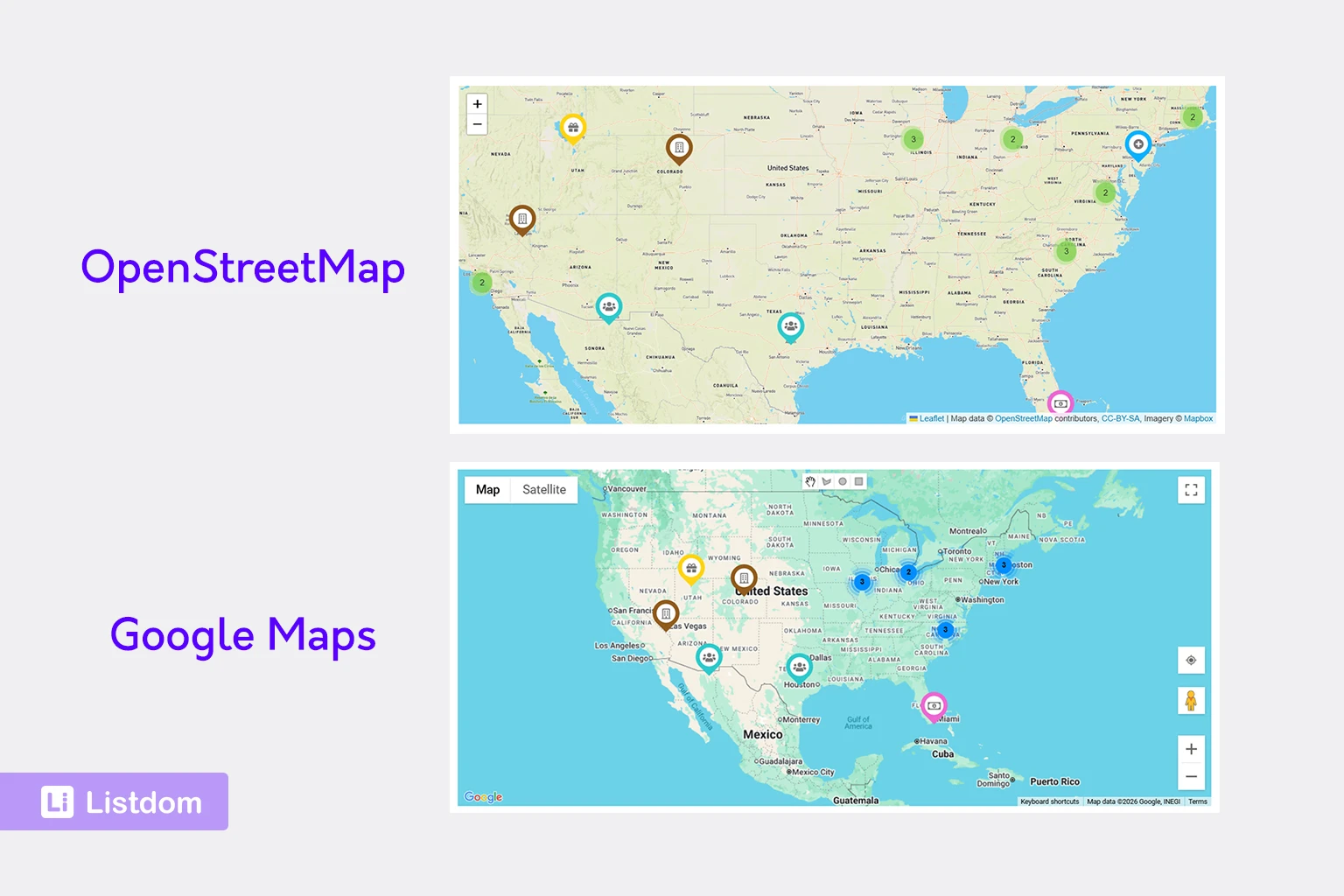
This is one of the first things a buyer should check.
A good WordPress Leaflet and Google Map listing plugin should not trap you in only one map provider if your project needs flexibility.
Some sites prefer Google Maps because of familiarity, route support, or existing workflow.
Others prefer OpenStreetMap and Leaflet because they want a more open map stack.
Listdom is stronger here because it supports both Google Maps and OpenStreetMap (Leaflet) in its map-based listing workflow.
That matters because the provider decision affects cost, API setup, design expectations, and sometimes which advanced map behaviors make the most sense later.
Helpful related reading:
- How Listings, Categories, and Locations Work in Listdom
- How Listdom Settings Work: Global, Shortcodes, Search, and Add-ons
From the product side, the broader provider setup is part of Listdom → Settings → General.
2. Address, coordinates, and location structure

A WordPress Leaflet and Google Map listing plugin is only as useful as the location data behind it.
That means a better plugin should support more than a loose address field.
In practical terms, map-based directories often need:
- a full address
- coordinates or accurate map placement
- a cleaner location structure for broader browsing
- category plus location logic working together
Listdom is stronger here because it combines map-ready listing data with a proper Locations taxonomy. That means you can organize listings with a parent-child location structure such as country → state → city → neighborhood while still using full address and map data where exact placement matters.
This matters because map browsing becomes much weaker when locations are messy or when addresses are not treated carefully enough.
Helpful related reading:
The practical content path for the location layer is Listings → Locations.
3. Map display quality across different views
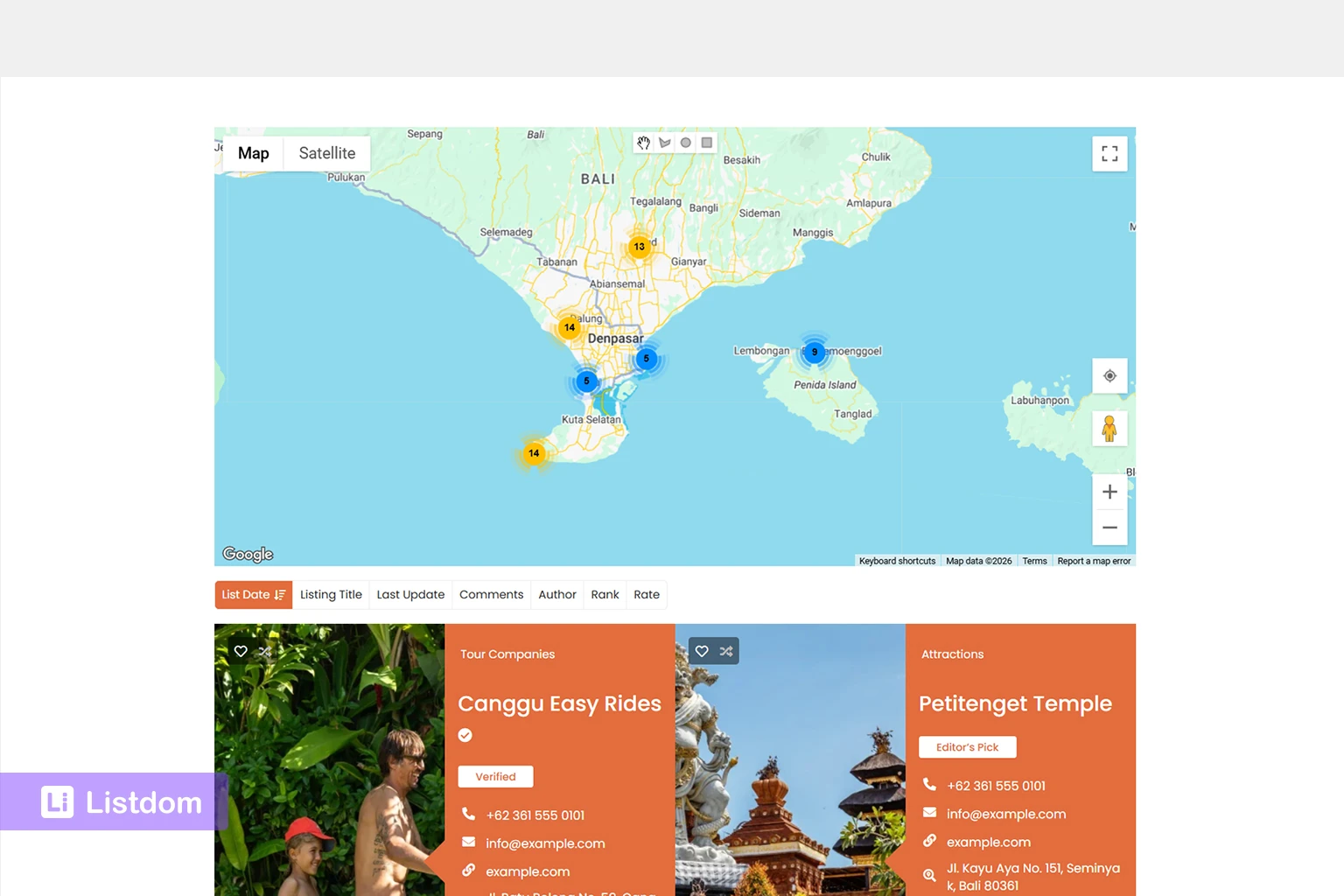
A strong WordPress Leaflet and Google Map listing plugin should do more than place one map on one page.
It should support different map jobs across the site.
For example, a map-based listing site may need to:
- show one listing on its own map
- show many listings together in a map-first view
- combine maps with list or grid outputs
- use half-map layouts where browsing and map context stay visible together
This is one of the reasons Listdom is stronger. It does not treat maps as a small add-on stuck beside a listing. It includes multiple map-aware display paths, including map-focused shortcode skins, and the docs also show support for a Single Map skin plus a Simple Map Shortcode for standalone map use cases.
That gives you more flexibility than plugins that only let you add one generic listings map block to a page.
Helpful related reading:
- How to Display Listings Using Listdom Shortcodes
- How Listdom Shortcodes, Search Forms, Archives, and Pages Work Together
4. Search and nearby discovery
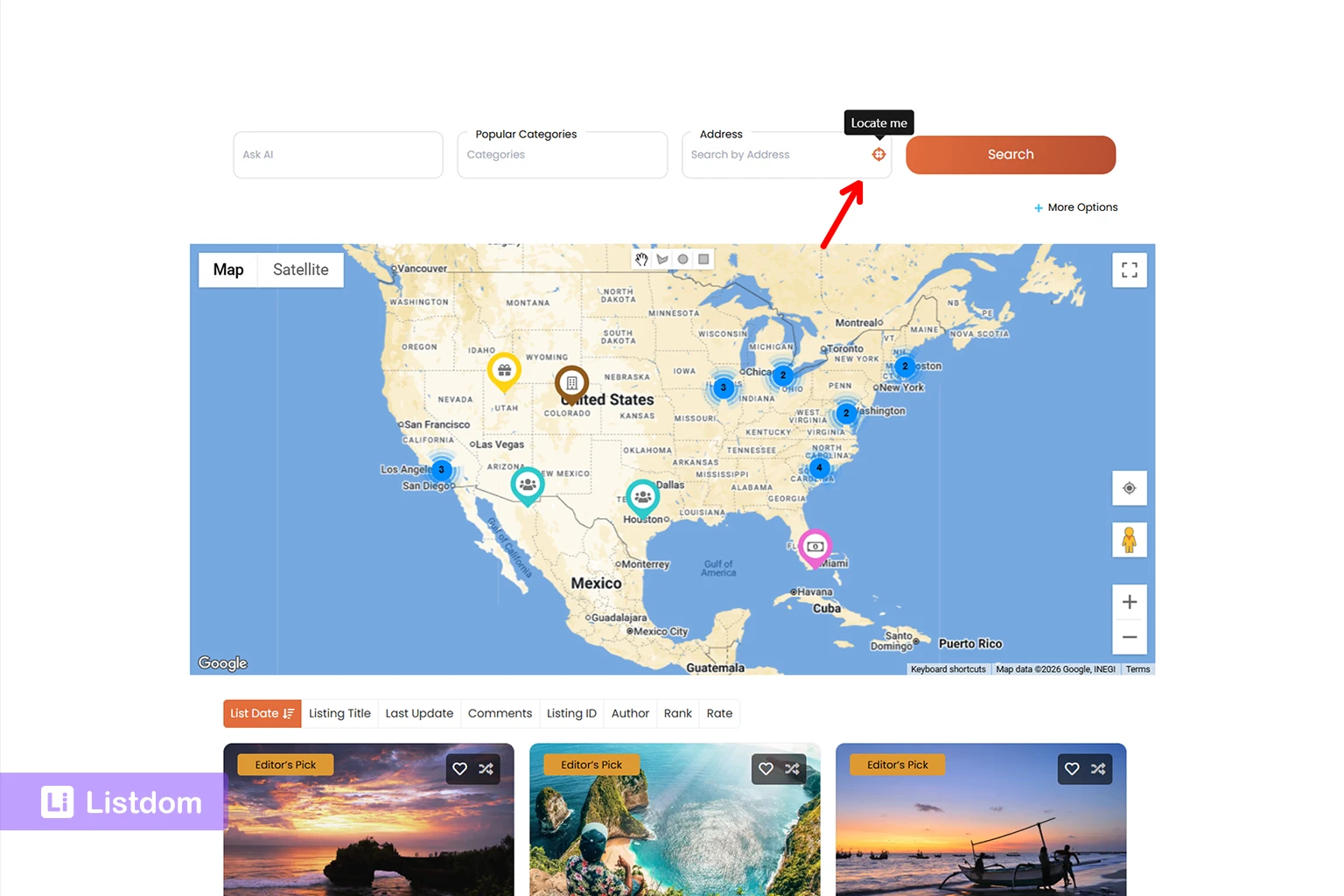
A WordPress Leaflet and Google Map listing plugin becomes much more useful when maps and search work together.
This is where many simpler plugins start to feel weak.
At a practical level, map-driven discovery often needs:
- keyword search
- category search
- location filtering
- address search
- nearby or radius-based search
- same-page or dedicated results-page behavior depending on the site model
Listdom is stronger here because search forms are not isolated from the display layer. In the Search and Filter Builder, the Address field is where several important local-search features come together. It can support plain address search, address autocomplete, the Locate Me button, a radius search field, or a radius dropdown depending on how you want the search experience to work. That makes it easier to build near-me or nearby-style local discovery instead of relying only on broad city pages.
This matters because map users often want to find what is near them, not just browse a static map.
Helpful related reading:
- How to Create Search Forms in Listdom
- How Listdom Shortcodes, Search Forms, Archives, and Pages Work Together
5. Advanced map behavior
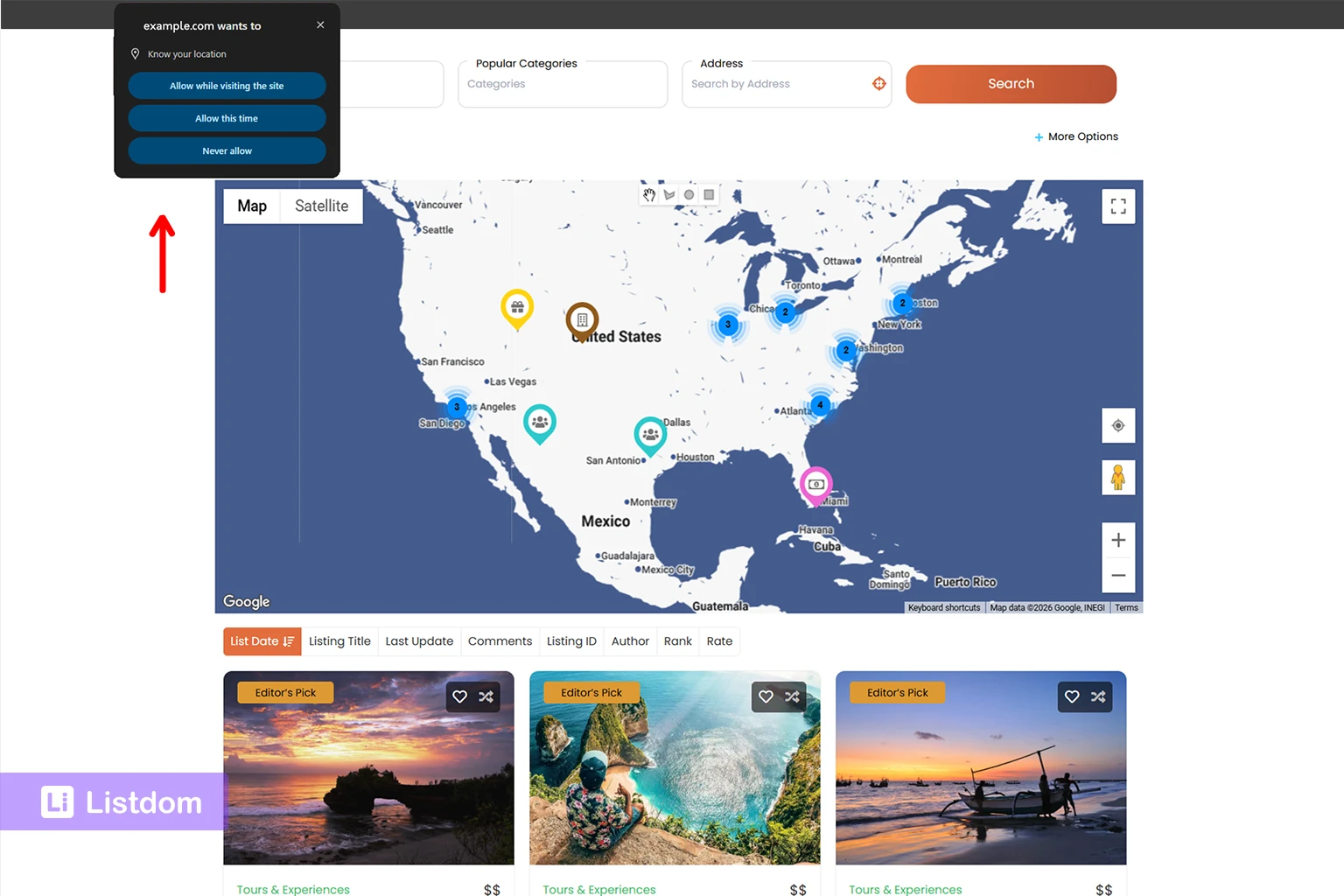
This is often where serious map-based projects separate from basic ones.
A stronger WordPress Leaflet and Google Map listing plugin should leave room for better map behavior when the site grows.
This can include things like:
- stronger marker styles
- richer infowindows
- better control over map boundaries
- category-specific map logic
- directions and route help
- user geolocation behavior
- layered geographic overlays
This is one of the strongest reasons Listdom stands out. The Advanced Map Addon adds deeper map behavior such as custom marker styles, infowindow styles, map bounds restriction, category exclusions on maps, and geo-direction features. The docs also note that Auto GPS in supported map skins works with both Google Maps and OpenStreetMap (Leaflet), and that the addon supports richer internal direction behavior on listing pages. For projects that need geographic overlays such as boundaries or routes, the KML Addon extends the map layer further.
That is a much stronger growth path than a plugin that only lets you drop default markers on a page.
6. Single listing pages and trust
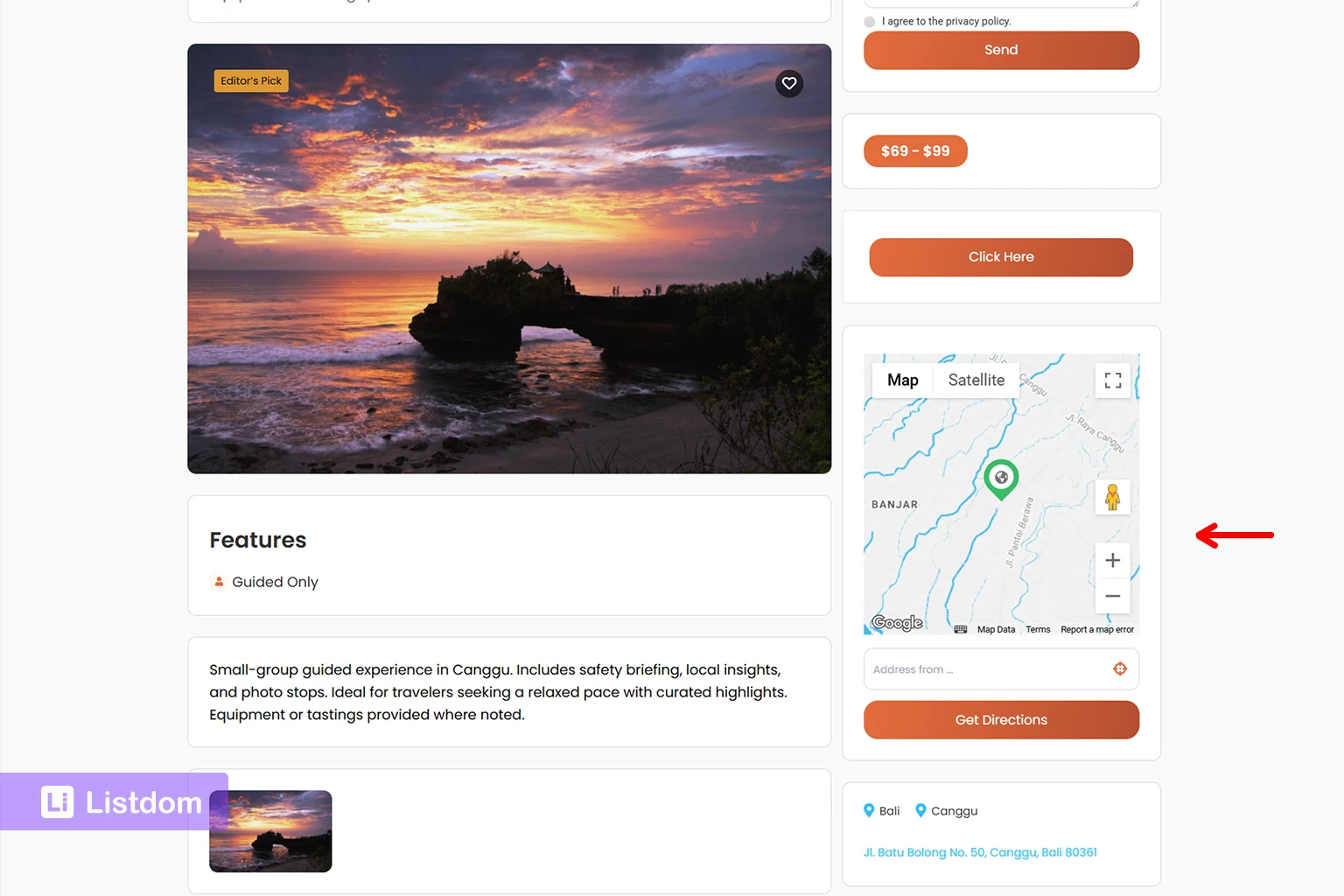
Maps do not only matter on archive or search pages.
They matter on the single listing page too.
A WordPress Leaflet and Google Map listing plugin should help the visitor do more than view a marker. It should help them trust the location and act on it.
That often means the single listing page should support things like:
- clear address context
- map visibility when location matters
- clickable directions or route actions
- business detail that makes the location useful, not decorative
Listdom is stronger here because the map and address layer connect naturally to the single listing experience instead of feeling isolated from it.
Helpful related reading:
Ready-made demos for map and local directory evaluation
Ready-made demos can help a lot when you are evaluating a WordPress Leaflet and Google Map listing plugin.
They matter because map-based workflows are easier to judge when you can explore a working site instead of imagining everything from a features list.
With Listdom, the ready-made demo sites are imported with the Listdomer theme. That means the demo layer is useful for seeing how Listdom and Listdomer can work together for map-heavy and location-driven directory projects.
For this kind of article, the demos are useful because they help you evaluate things like:
- Map-first browsing feel
- Category and location structure in a real site
- How search and archive browsing work beside maps
- How single listing pages present the address and map details
- How a local or city-style directory can feel before you build everything manually
A good practical way to think about it is this:
- Listdom provides the directory system, map logic, search, structure, and add-on depth
- Listdomer provides the ready-made starter site and demo-import experience
If you want the broader demo overview, see How to Import and Understand Listdom Demos.
The turning point: when map support stops being enough
A lot of plugins can technically support listings with maps.
The real problem starts when the map needs to do more than prove that a location exists.
That turning point usually comes when you need several of these together:
- both Google Maps and Leaflet-based flexibility
- stronger address and location structure
- search forms that support local discovery well
- map-first and shortcode-based display options
- nearby search behavior
- richer infowindows, directions, or bounds control
- room for local-search and map-based growth later
At that stage, the map is no longer just a visual helper. It becomes part of how the site is searched, browsed, and trusted.
That is exactly where thinner map plugins start to feel restrictive, and where Listdom becomes more compelling.
How Listdom handles the map workflow better
One reason Listdom feels stronger is that the map layer is not isolated from the rest of the plugin.
Instead of treating maps like a final cosmetic add-on, it lets you build the workflow in a more connected order:
- define categories and locations
- choose the map provider in Listdom → Settings → General
- add address and map-ready listing data
- build search forms in Listdom → Search and Filter Builder
- use shortcode skins and archive paths for visual browsing
- add advanced map features only when the site really needs them
- let single listing pages handle the final trust and action layer
That workflow is the practical difference between a plugin that merely places listings on a map and a system that uses maps as part of discovery.
Projects that benefit most from this map stack
This approach is especially useful when the site is meant to be explored geographically, not just read like a list.
Examples include:
- city directories
- local discovery websites
- service directories with map-first browsing
- property-style or location-driven directories
- business directories where maps are part of the real user journey
- projects that may later need stronger local-search and map workflows
Listdom becomes an especially strong fit when you need several layers working together at once, such as categories and locations, map provider flexibility, address and radius search, map-aware shortcode views, and stronger single listing map detail.
Build light or build for growth?
Not every site needs the full depth of a stronger map-aware directory system.
A simpler plugin may still be enough when:
- the site is very small
- the map is only a light supporting feature
- local search is basic
- only admins manage listings
- nearby search and advanced map behavior are not important
- long-term growth is unlikely
But if the site is meant to become a stronger local-discovery tool, those limits usually show up earlier than expected.
So the real choice is often not between a cheap map plugin and a feature-rich one. It is between a lighter setup for a small project and a stronger foundation for a site that will grow.
A quick test before you commit
Before choosing a WordPress Leaflet and Google Map listing plugin, ask yourself:
- Do I need freedom between Google Maps and OpenStreetMap or Leaflet?
- Will exact address data and broader location structure both matter on this site?
- Does local discovery depend on search, nearby results, and maps working together?
- Will I need more than one map display pattern, not just one static map block?
- Could this site need better directions, overlays, or stronger map controls later?
- Am I choosing a plugin that helps users discover results better, not only view markers?
If several of those questions matter to your project, the safer choice is usually the plugin with the stronger long-term map workflow.
What to explore next if you are evaluating Listdom for maps
If you want to evaluate Listdom more seriously for map-based use cases, these are the best next articles:
- How Listings, Categories, and Locations Work in Listdom
- How to Create Search Forms in Listdom
- How Listdom Shortcodes, Search Forms, Archives, and Pages Work Together
- How Taxonomy Archive Pages Work in Listdom
- How Single Listing Pages Work in Listdom
These articles give a much clearer picture of whether Listdom fits the kind of map-based listing site you actually want to build.
Final thoughts
The best WordPress Leaflet and Google Map listing plugin is not only the one that can render a map.
It is the one that helps visitors discover the right result through maps, search, structure, and listing detail.
That means the real comparison should focus on:
- map provider flexibility
- address and location quality
- search and nearby discovery
- display options across archive and shortcode views
- single listing usefulness
- long-term map-based growth
Listdom is a stronger choice when you want a WordPress Leaflet and Google Map listing plugin that works as a connected local-discovery system rather than a thin map layer attached to listings.
That is the real reason it deserves to be considered one of the strongest options in this space.
FAQ
What should a WordPress Leaflet and Google Map listing plugin include?
It should support map-provider flexibility, address and location handling, practical search, map-ready display views, and enough listing detail to make the map useful in real life.
Is it enough for a plugin to support only Google Maps?
Sometimes, but not always. A stronger WordPress Leaflet and Google Map listing plugin gives you more flexibility if your project prefers OpenStreetMap or Leaflet-based workflows.
Why is Listdom a stronger choice for map-based directories?
Because it connects maps, address data, search forms, location structure, shortcode views, and single listing pages more naturally than many simpler plugins.
Do I need advanced map features from the beginning?
Not always. But if your site may later need richer infowindows, directions, overlays, or stronger map controls, it is better to choose a plugin that already supports that growth path.
Are maps enough without search and location structure?
Usually no. A better map-based directory needs structure and discovery logic too, not only markers on a map.
Can Listdom support ready-made map and local-directory demos?
Yes, through the Listdomer theme demo-import workflow, which helps you evaluate map and local directory setups faster.