The best directory website niches are not simply the biggest markets. They are the markets where people repeatedly need a specific, current answer and where the directory can make that answer easier to trust and act on. That may be a local service, a specialist, a property, a venue, or an opportunity—but the niche must be useful before it can be monetized.
This guide helps you choose a directory idea before you choose a theme, import a demo, or build a search form. The goal is not to find a universal “most profitable” niche. It is to find a focused directory model that you can supply with good information, explain clearly to visitors, and grow into a useful product.

The best directory website niches are not simply the biggest markets. They are the markets where people repeatedly need a specific, current answer and where the directory can make that answer easier to trust and act on. That may be a local service, a specialist, a property, a venue, or an opportunity—but the niche must be useful before it can be monetized.
This guide helps you choose a directory idea before you choose a theme, import a demo, or build a search form. The goal is not to find a universal “most profitable” niche. It is to find a focused directory model that you can supply with good information, explain clearly to visitors, and grow into a useful product.
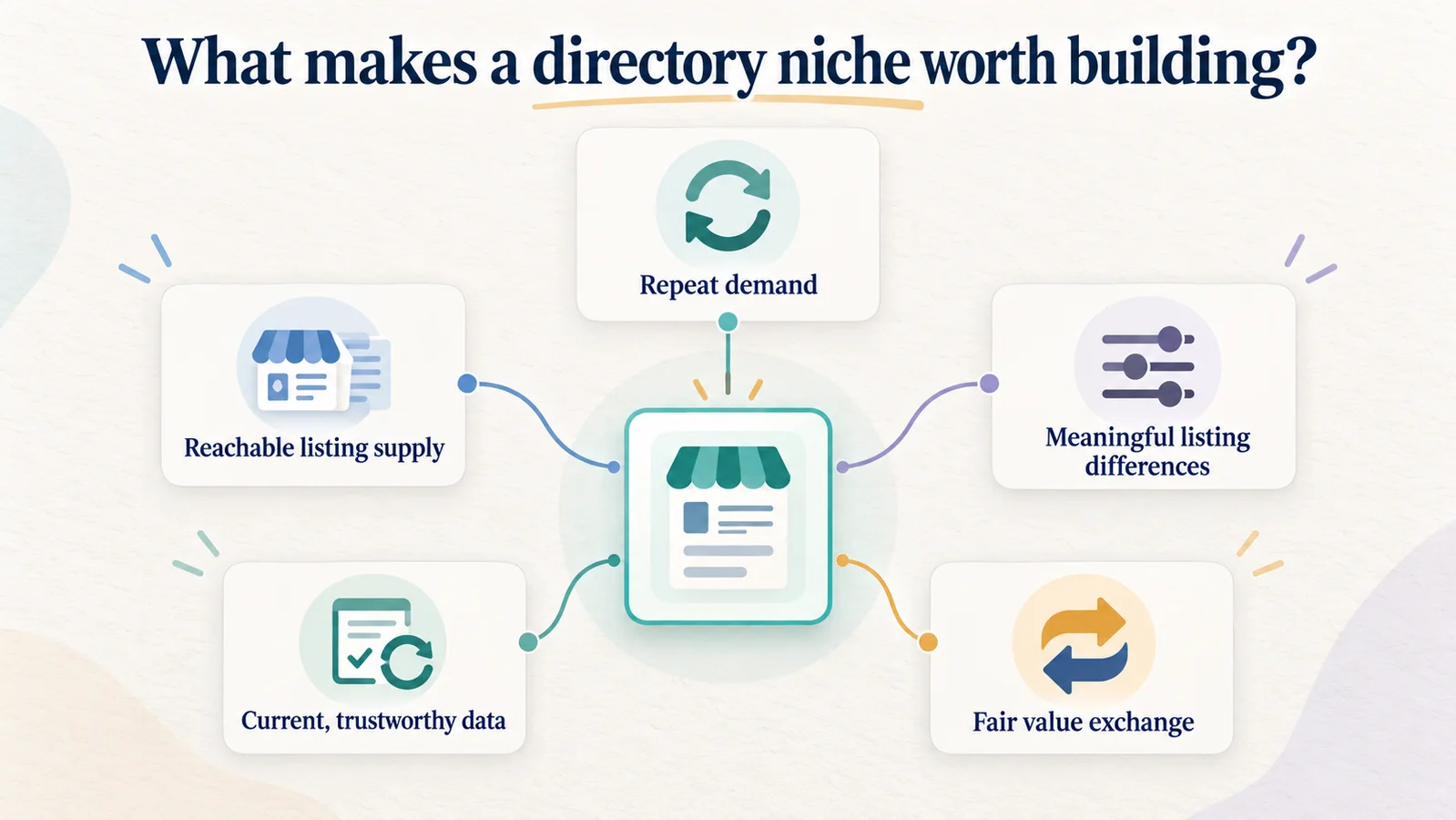
What makes a directory niche worth building?
A good directory solves a repeated discovery problem. Visitors should arrive with a question that is more specific than “tell me about this topic.” They may need to find a qualified provider nearby, compare options with real criteria, see what is currently available, or take the next step with confidence.
That means a promising niche usually has five qualities:
- Repeat demand. People need the information more than once, or new people enter the market regularly.
- A reachable supply of listings. You can identify businesses, professionals, venues, properties, or organizations to include without depending on an impossible data-collection effort.
- Meaningful differences between listings. The visitor needs filters, details, location context, credentials, availability, pricing signals, or another comparison layer—not only a name and phone number.
- A clear reason to keep the information current. Owners, editors, or contributors have an incentive to correct details, claim profiles, or add better information.
- A realistic payer or value exchange. The directory can eventually support a relevant revenue model, such as enhanced profiles, membership, promotion, leads, sponsorship, or an appropriate referral relationship.
A useful test is this: after reading a listing, can the visitor make a better decision than they could from a generic answer? A directory is strongest when it adds current local context, verified ownership, structured details, or a clear next action.
Start narrower than the category sounds
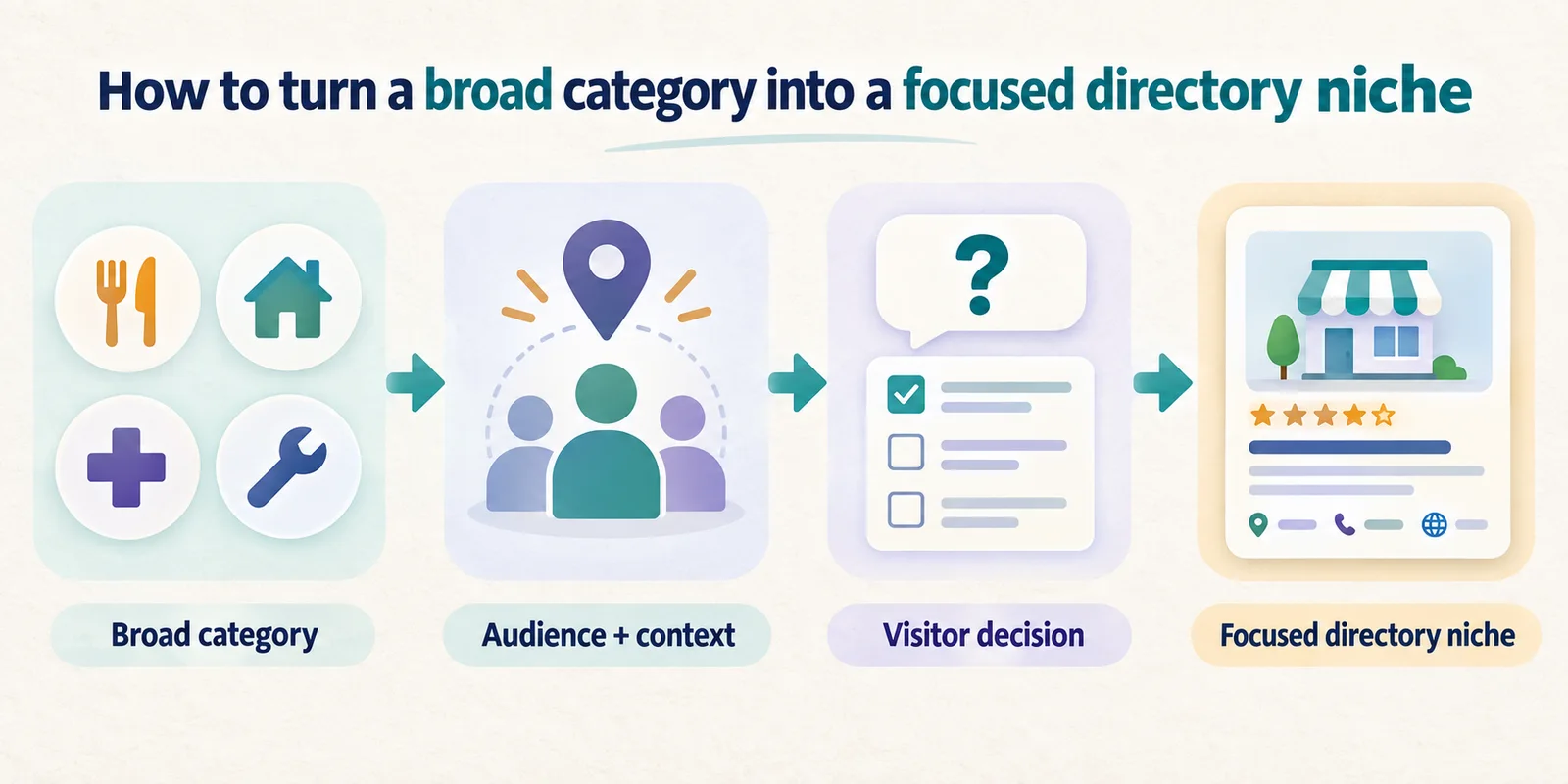
“Local businesses,” “restaurants,” or “real estate” are categories, not yet a niche. They are too broad to tell you whose problem you solve, how you will collect listings, or why visitors should return.
A niche becomes practical when you combine an audience, a geography or context, and a decision.
For example:
- dog-friendly cafes in a single metropolitan area
- accessible holiday accommodation near major transport hubs
- independent architects for sustainable renovations in a region
- therapists offering a defined service and language support
- commercial kitchens available for hourly hire
- property managers who work with a particular type of rental
This does not mean every directory must stay tiny. It means the first version should be easy to explain in one sentence. A focused launch gives you a clearer list of businesses to contact, simpler categories, fewer speculative filters, and a more believable reason for an owner to participate.
Test the niche before you build pages
Before designing a homepage, write down the answers to these questions.
What is the visitor trying to decide?
The strongest directory website ideas begin with a decision, not with a list of businesses. A visitor may be choosing a doctor, a restaurant for a dietary need, a nearby contractor, a suitable property, or a venue for a specific event.
If the decision is vague, the site will often become a loose collection of listings. If it is clear, you can define which information belongs on a listing and which filters deserve space in search.
What information needs to be maintained?
Look for information that changes or needs local verification: address, service area, hours, credentials, menu links, current availability, price range, accepted insurance, accessibility details, or direct contact routes.
This matters more as people use AI-assisted search. A broad answer can help someone begin research, but it cannot reliably replace a maintained directory that shows who currently operates in a place, what they actually offer, and where a visitor can take the next action. The value is not “having data”; it is being accountable for useful, structured, current data.
Who can supply the listings?
Do not assume businesses will submit complete profiles on day one. Decide whether the first listings will come from your own research, a curated import, partner organizations, owners, or a mixture of these sources.
Then ask what would make a listing owner care: profile ownership, qualified visibility, an accurate public presence, leads, an easier update path, or a trusted niche audience. This is also where moderation matters. A directory that cannot explain who updates its most important information will struggle to earn trust.
Is there a reason to pay later?
You do not need to charge at launch. In fact, charging before a directory demonstrates value is often counterproductive. But you should be able to describe a fair future exchange.
For example, a local service directory may later offer enhanced profiles or featured placement. A specialist directory may offer membership to organizations that need richer profiles. A travel guide may earn through carefully disclosed referral links. A marketplace-like directory may lead toward transactions only if the workflow truly needs them.
For a broader explanation of these choices, read how to monetize a directory listing website. The important point at this stage is fit: the revenue model should support the visitor’s task rather than interrupt it.
Directory website niches with strong starting models
These examples are not promises of revenue. They show how a niche, its data, and its user decision can fit together.
Local specialist services
Local service directories work when “near me” is not enough. A focused directory for restoration specialists, family photographers, EV-charger installers, language tutors, or accessibility consultants can help visitors compare real qualifications, service areas, response methods, and relevant proof.
Start with a defined area and one service family. Useful listing fields might include service radius, certification, service type, pricing approach, availability signal, and contact route. A generic local-business directory can later become a broader product, but a specialist launch is usually easier to populate and explain.
City and neighborhood guides
A city guide is valuable when it organizes choices around a visitor’s situation: family-friendly activities, coworking spaces, independent shops, wedding venues, accessible places, or neighborhood services.
The directory needs more than a map pin. It needs a reason for someone to use its categories and details instead of a general map search. Neighborhood context, editorial selections, practical amenities, and accurate opening or access information can make the guide useful for both residents and visitors.
Real estate and property professionals
Property directories can represent homes, commercial spaces, agents, agencies, property managers, or service providers around housing. The right model depends on the decision you support. A rental search, an agent directory, and a property-services guide are different products with different listing fields and ownership workflows.
Do not begin by trying to replicate a national property portal. Choose a bounded model such as local agents with verified specialties, student accommodation in one city, or commercial properties in a particular sector. When you are ready for the implementation path, see how to create a real estate directory with WordPress.
Healthcare and wellbeing providers
Healthcare directories are especially dependent on trustworthy details. Visitors may need specialty, location, language, referral information, accessibility, contact methods, or a clear distinction between a clinic and an individual provider.
That makes this a strong niche only when you can set sensible editorial boundaries and review important claims. It is not a good fit for unmoderated profiles that imply medical advice or availability you cannot substantiate. Our healthcare directory website guide explains the data and search decisions that follow once the model is chosen.
Restaurants, hospitality, and experiences
Restaurants and hospitality listings work best when the directory serves a clear need: a cuisine, an accessibility need, a travel context, a neighborhood, a dietary preference, or a type of experience. A broad restaurant list is difficult to differentiate; a guide to halal brunches, independent hotels near a convention center, or family-friendly stays can have a more useful editorial point of view.
The information must be maintained. Opening hours, reservation links, menus, dietary options, amenities, and location context are often the details that turn a directory into a decision tool. Explore the practical models in our restaurant directory guide and hotel directory guide.
B2B suppliers and professional networks
B2B niches often work when the buyer needs evidence of specialization rather than a long list of vendors. Examples include packaging suppliers, legal translators, accessibility auditors, grant consultants, or industrial maintenance firms.
These directories can support rich service details, sectors served, qualifications, project scale, geography, and inquiry routes. They are often less dependent on high consumer traffic, but they demand careful positioning: the audience must be specific enough that a supplier sees value in being found there.
Jobs, opportunities, and curated classifieds
An opportunity directory can cover specialist jobs, local volunteering, creative commissions, shared workspaces, or equipment hire. The distinction is that the listing is time-sensitive. The work is not only publishing listings; it is removing stale ones and making status clear.
This model is worth considering when you have a direct path to current supply. Without that, outdated opportunities quickly damage the product’s value. Start with one audience and one kind of opportunity before adding a marketplace or transaction layer.
Match the revenue model to the value you create
The most durable directory monetization is usually aligned with a real advantage for the listing owner.
| If the directory helps owners… | A possible future model |
|---|---|
| Be accurately represented in a trusted niche | Claimed or enhanced profile |
| Compete for visibility where visitors are actively comparing options | Featured placement or sponsorship, clearly labeled |
| Reach a professional audience repeatedly | Membership or organization profile |
| Receive a qualified inquiry | Lead-related or service-based pricing, only when the workflow supports it |
| Refer a visitor to an external booking or purchase route | Disclosed referral relationship |
Avoid copying a revenue model because it works for a much larger platform. A paid submission can make sense for a curated professional directory with established demand; it can discourage the supply you need in a new local guide. Advertising can suit a high-traffic editorial destination; it can distract from a high-trust healthcare search.
Design the first version around trust, not feature count
Your first release does not need every directory feature. It needs a small, coherent structure that lets visitors understand what each listing represents and how to use it.
Define:
- the listing type
- the primary categories
- the location model
- the few details that affect a visitor’s choice
- the one or two filters that answer the main question
- who owns or reviews important information
- the action a visitor should take after finding a listing
This structure also makes the content clearer for search engines, answer engines, and people. Clear categories, meaningful fields, accurate locations, and maintained listing pages are better foundations than generic copy or a long, unfocused filter panel.
Before choosing a skin or a demo, use this directory structure planning guide to separate categories, locations, custom fields, and search needs. That exercise will show whether your niche is truly focused enough to build.
Where Listdom fits after you choose the niche
Listdom is most useful after the directory model is clear. It gives you the building blocks to represent that model with listings, hierarchical categories and locations, custom attributes, search and filter forms, map-based results, and—where the project needs it—frontend listing management.
The key decision is not to turn every possible detail into a filter. Decide first which fields make the visitor’s decision easier. A restaurant guide may need cuisine, dietary options, neighborhood, and opening information. A professional directory may need specialty, credentials, service area, and inquiry route. A property directory may need an entirely different set of criteria.
Once you have that model, build your directory website with WordPress using Listdom and then configure the structure around your real user journey.
Common mistakes when choosing a directory niche
Starting with a giant, generic market
Large markets look attractive, but they make supply, moderation, search, and differentiation harder at the same time. Start with a segment you can describe, reach, and maintain.
Treating a list as a directory
A list of names is not enough when visitors need to compare options. If no structured detail or next action is needed, a well-written article or collection page may be the better product.
Adding filters before knowing the decision
Every filter should help a real visitor choose. Too many speculative fields create a complicated form, low-quality data, and a confusing experience.
Monetizing before trust exists
Do not make a new listing owner pay for visibility before the directory gives them a credible reason to believe it will help. First create a useful destination, then develop fair upgrade options.
Leaving essential data stale
Stale address, ownership, availability, or credential details undermine the very advantage a directory can provide. Decide early how owners can update information and how the most important changes will be reviewed.
What to do next
Choose one niche statement, then test it with a small set of real listings. If you cannot decide which fields, categories, locations, or filters those first listings need, the niche still needs work.
When the model is clear, continue with building a directory website with WordPress. If the main challenge is commercial fit rather than setup, start with the directory monetization overview.
FAQ
What are the best directory website niches?
The best directory website niches have repeat demand, an accessible supply of listings, meaningful information to compare, and a realistic way to keep that information current. Local specialist services, focused city guides, professional networks, property-related directories, hospitality guides, and opportunity directories can all work when they solve a specific decision.
What is the most profitable directory website niche?
There is no universal answer. A smaller niche with clear demand, reliable listing supply, and a fair value exchange can be more sustainable than a large generic directory that is difficult to maintain or differentiate.
How narrow should a new directory website be?
Start narrow enough that you can explain the audience, the decision, the first listings, and the key fields in one sentence. You can expand after the initial model proves useful; it is much harder to make a vague directory specific later.
Can a directory still be useful when people use AI search?
Yes, when it offers maintained, structured, locally relevant information and a clear next action. A directory should help visitors verify details, compare real options, identify the current owner or provider, and move from research to contact, booking, inquiry, or another appropriate action.
Do I need to decide monetization before building a directory?
You should decide the potential value exchange before building, but you do not need to charge on day one. The niche should support a credible future model without making payment the barrier to collecting your first useful listings.
Can I build a niche directory website with WordPress and Listdom?
Yes. After you define the listing model, Listdom can support structured listings, categories, locations, custom attributes, search forms, map results, and related directory workflows. Start with the WordPress directory website guide to plan the build sequence.
FAQ
Common questions
What are the best directory website niches?+
The best directory website niches have repeat demand, an accessible supply of listings, meaningful information to compare, and a realistic way to keep that information current. Local specialist services, focused city guides, professional networks, property-related directories, hospitality guides, and opportunity directories can all work when they solve a specific decision.
What is the most profitable directory website niche?+
There is no universal answer. A smaller niche with clear demand, reliable listing supply, and a fair value exchange can be more sustainable than a large generic directory that is difficult to maintain or differentiate.
How narrow should a new directory website be?+
Start narrow enough that you can explain the audience, the decision, the first listings, and the key fields in one sentence. You can expand after the initial model proves useful; it is much harder to make a vague directory specific later.
Can a directory still be useful when people use AI search?+
Yes, when it offers maintained, structured, locally relevant information and a clear next action. A directory should help visitors verify details, compare real options, identify the current owner or provider, and move from research to contact, booking, inquiry, or another appropriate action.
Do I need to decide monetization before building a directory?+
You should decide the potential value exchange before building, but you do not need to charge on day one. The niche should support a credible future model without making payment the barrier to collecting your first useful listings.
Can I build a niche directory website with WordPress and Listdom?+
Yes. After you define the listing model, Listdom can support structured listings, categories, locations, custom attributes, search forms, map results, and related directory workflows. Start with the WordPress directory website guide to plan the build sequence.