Ten years ago, getting found online meant one thing: rank on Google’s first page. That’s no longer the whole game. Shoppers now ask ChatGPT to compare products, let Google’s AI Overviews summarize their options, and increasingly buy without ever clicking a traditional search result.
If your store isn’t structured in a way these systems can read, you’re invisible to a growing share of buyers before they ever see your homepage.
Structured data for ecommerce is the behind-the-scenes code that tells search engines and AI systems exactly what your products are, and it’s how you fix that. Paired with the right AI tools, it turns your store from something a human has to stumble onto into something a machine can confidently recommend.
Here’s what’s changed, what structured data actually does, and how to make your WordPress store findable in both worlds.
Why ‘Getting Found’ Doesn’t Mean Google Anymore
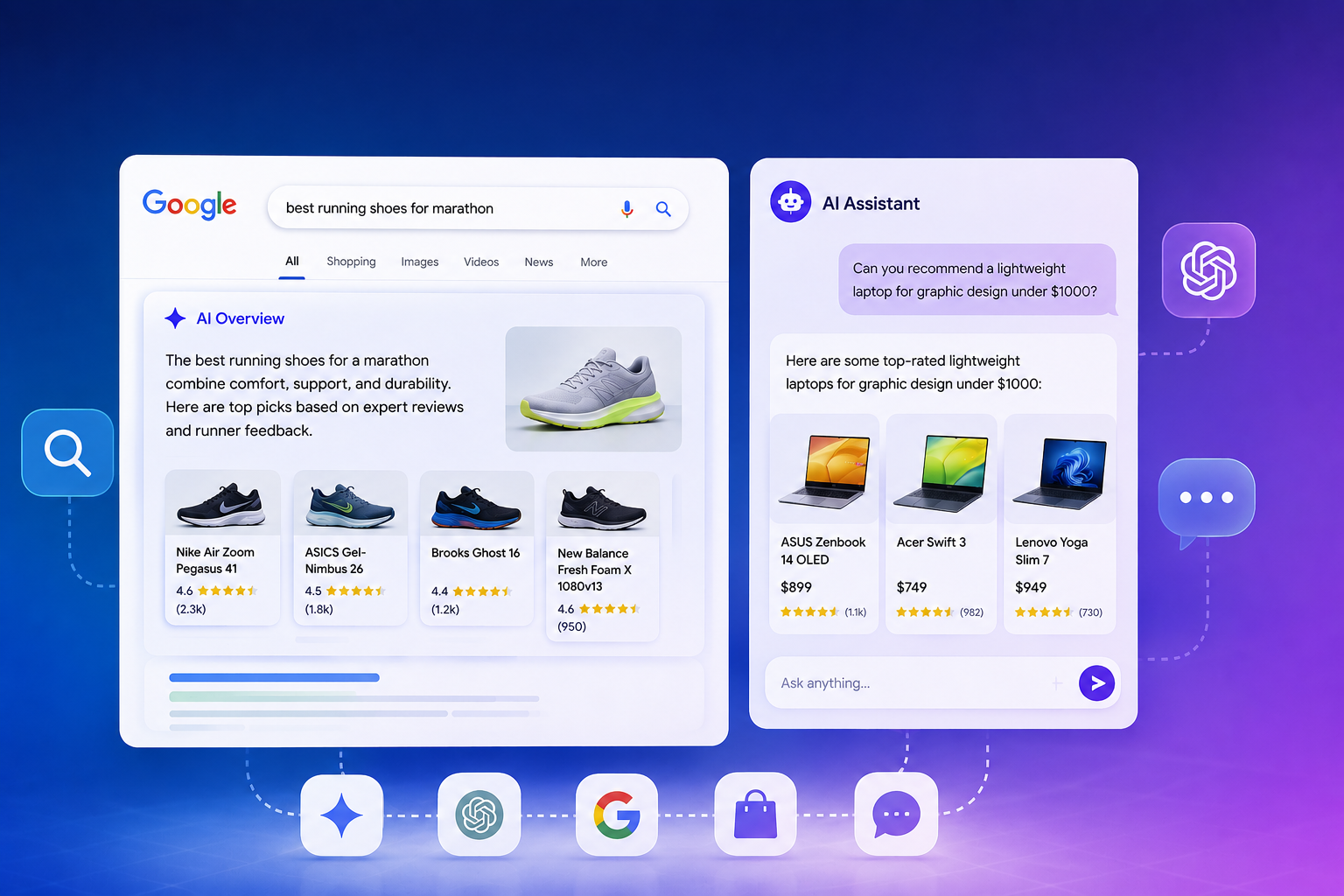
Search used to be a single destination. Now it’s a handful of surfaces, and each one reads your store differently.
Search Is Moving Toward AI Shopping
Google’s AI Overviews have moved well past informational queries into shopping itself. A Visibility Labs analysis of 20.9 million shopping SERPs, reported by Search Engine Land, found AI Overviews appearing on 14% of shopping searches by March 2026, up 5.6 times from just four months earlier.
That’s not a niche feature anymore. It’s a meaningful slice of shopping search turning into a page your product might never appear on if your data isn’t structured for it.
At the same time, OpenAI has been expanding ChatGPT’s shopping experience, letting users browse products visually, compare options side by side, and get detailed information pulled from merchant catalogs, all without leaving the conversation. Retailers, including Target, Sephora, and Wayfair, have already connected their catalogs to this discovery layer.
How Shoppers Discover Products in 2026
A shopper today might type a product name into Google, ask ChatGPT to compare three options, or let an AI Overview summarize the field before they’ve even opened a tab. Each of these systems is reading your product data, not your marketing copy, to decide whether to show you. That’s the shift: discovery increasingly happens in a machine-readable layer sitting underneath your actual web pages.
What Structured Data for Ecommerce Really Does
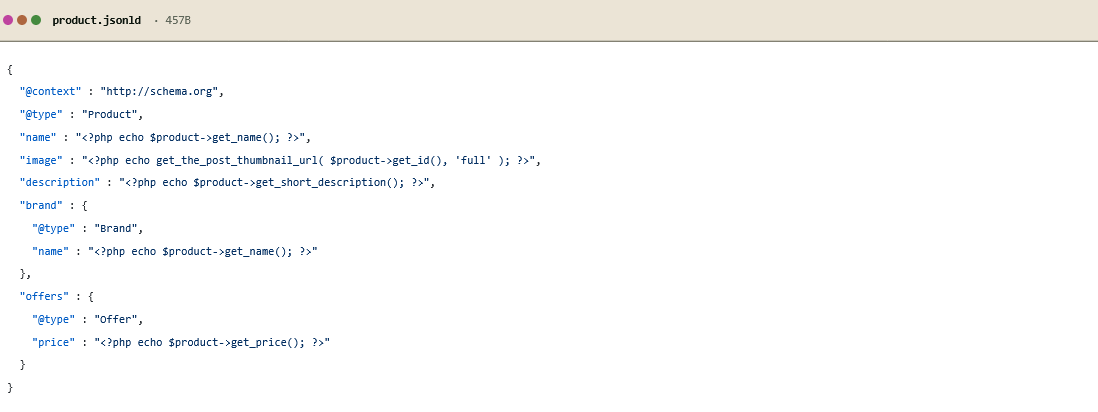
Structured data is a standard code format, usually JSON-LD, that helps search engines and AI tools understand your page.
For example, instead of asking Google to guess whether a number is a product price or an ID, structured data labels it clearly. It can identify details such as price, availability, ratings, brand, and product name.
Structured data does not directly improve rankings. However, it can make your pages eligible for rich results, including star ratings and enhanced product listings. It can also help AI systems understand and reference your content more accurately.
This matters because ranking on Google no longer guarantees visibility in AI-generated results. An Ahrefs analysis found that only 38% of pages cited in AI Overviews also ranked in Google’s top 10 for the same search.
The takeaway is simple. Clean and complete structured data gives search engines and AI systems a better chance of finding, understanding, and displaying your products.
Product Schema Fields You Should Not Skip
Google requires a minimum set of fields for the Product schema to be eligible for any rich result:
- Name
- Image
- And at least one of offers, review, or aggregateRating
For an actual shopping result, that expands to include price, currency, and availability inside the offer. Beyond the minimum, a handful of fields tend to separate stores that get cited from ones that don’t:
- Product identity: brand, SKU, and GTIN, which help Google match your listing to its Shopping graph
- Commerce basics: price, currency, availability, and how long the price is valid
- Social proof: aggregate rating and review count, sourced from real customer reviews only
Generic Product schema with placeholder-quality data doesn’t move the needle much. A February 2026 Growth Marshal study cited by SEO consultant Graeme Whiles found that attribute-rich schema, with real pricing, ratings, and specifications, is what actually drives AI citation, while thin implementations get passed over.
Here’s the catch for most WordPress store owners: on a stock setup, keeping all of that accurate is manual work. Every price change, stock update, or new review has to stay in sync between what shoppers see and what your schema declares, often across a plugin or two bolted on after the fact.
That maintenance gap is exactly where thin, stale schema comes from. (More on how to close it below.)
The Other Schema Types Worth Adding
Product schema carries the most weight, but it isn’t the whole picture. Organization schema establishes your brand as a known entity, useful when AI systems are trying to verify who’s actually selling the product.
The FAQPage schema helps question-and-answer content get pulled into AI-generated summaries. BreadcrumbList schema clarifies your site structure, so search engines understand where a product sits in your catalog instead of treating it as an isolated page. None of these replace Product schema. They round it out.
How AI Shopping Agents Decide to Show You

Google’s crawler and an AI shopping agent don’t read your site the same way, and that difference matters more than most stores realize.
Why AI Tools Rely on Structured Product Data
AI crawlers increasingly parse structured data as standalone information rather than working through your full HTML the way a traditional crawler does.
That means your JSON-LD needs to be rendered server-side. If your schema loads in dynamically through client-side JavaScript, an AI crawler that isn’t waiting around for scripts to execute may never see it at all. It also means the schema itself needs to actually match what’s on the page.
Nesting matters too: offers should sit inside the Product schema block they belong to, not floating in a separate script tag, or some AI systems will miss the connection entirely.
Product Details That Help AI Recommend Your Store
A few fields quietly decide whether an AI shopping agent trusts your store enough to recommend it. Return policy information, marked up through hasMerchantReturnPolicy, is one of the biggest gaps: most stores never declare it in the schema, even though shopping agents increasingly favor merchants who do.
Shipping details, including rate, destination, and delivery timeframe, answer the “can I get this by Friday” question an agent might field on your behalf. And a generic additionalProperty field lets you describe materials, certifications, or specifications that don’t fit neatly into the standard schema, giving agents something concrete to filter and compare on.
Miss these, and it’s not that your store performs worse. It’s that an agent skips you and recommends a competitor who filled in the gaps.
Adding Structured Data to a WordPress Store (Without Breaking It)
The good news for WordPress store owners is that you rarely need to hand-write JSON-LD.
Choose How to Add Structured Data
There are a few ways to add structured data:
- Plugin route (general SEO plugins)
- Dedicated schema plugins
- Built-in ecommerce support
- A JSON-LD Generator for one-off markup
Most general SEO plugins, including the well-known ones in the WordPress ecosystem, generate basic schema automatically for posts, pages, and simple content types. Dedicated schema plugins go further, letting you apply conditional rules across large catalogs.
Ecommerce plugins that build schema into product management directly cut out a step: you’re not bolting structured data onto your store after the fact; you’re generating it from the same product data your store already runs on, which keeps price, availability, and stock levels in sync without a second system to maintain.
Building your store from scratch? EasyCommerce gets you a schema-ready WordPress store live in minutes, and because it’s a single, lightweight system rather than a stack of add-ons, your price, stock, and availability stay in sync with your structured data instead of drifting apart. Get the free plugin.
Test Your Structured Data
Once the schema is live, validate it. Google’s Rich Results Test shows exactly what a search result could look like and flags missing required fields. The Schema.org validator is stricter and catches structural issues that Google’s tool sometimes misses. Run both on your highest-traffic product pages first, then expand to other pages.
Common Structured Data Mistakes to Avoid
Partial implementation is the most common failure. A Product schema block missing aggregateRating won’t show a star rating, even if every other field is perfect; there’s no partial credit.
A schema that doesn’t match the visible page content is another common pitfall, as search engines can penalize mismatches instead of rewarding the extra data. And schema injected only through client-side JavaScript risks never being read by the crawlers that matter most for AI visibility, as covered above.
Start Your Online Store With EasyCommerce
If you don’t have a store yet, none of the schema work changes. You still need clean Product schema, the fields most stores skip, and validated markup. What changes is how fast you get to a store that’s built to carry that schema, instead of one you’re patching together from a base cart and a stack of plugins.
A Lighter, Faster Foundation Than a Stock WooCommerce Stack
EasyCommerce is a free WordPress ecommerce plugin built to get a store live fast, and to keep it lightweight instead of ballooning into a pile of add-ons you have to reconcile every time a price changes. Its AI tools speed up the build:
- AI Copy Writer drafts product descriptions instantly
- AI Template Generator builds store and product page templates in seconds
- AI Smart Search helps shoppers find what you sell without fighting your menu
These tools get the store itself built and running faster, so your time goes into the schema and findability work above rather than into setup. The core plugin is free, add-ons included, with no hidden feature gates on the essentials.
To be straight with you: EasyCommerce’s AI tools don’t generate your structured data or place you in AI Overviews. What they do is hand you a fast, clean store as the foundation. The schema and validation steps in this guide are what make it discoverable.
Where AI Shopping Agents Fit In
Once your store is live and properly structured, AI shopping agents become a sales channel in their own right. Shoppers who arrive through an AI-referred recommendation tend to convert well, because the agent has already matched them to a product that fits what they asked for.
That’s a downstream payoff of the structured-data work above, not something the build tools produce on their own, but it’s a real reason to take those steps seriously.
A 6-Point Findability Checklist Before You Publish
Whether you’re auditing an existing store or launching a new one, run through this before you call your product pages done:
- Audit your Product schema. Confirm name, image, brand, SKU, price, currency, and availability are present and accurate on every product page.
- Add return and shipping details. Mark up hasMerchantReturnPolicy and shippingDetails, the fields most stores skip and AI agents increasingly check.
- Check AI crawler access. Review your robots.txt to confirm you’re not accidentally blocking the bots that power AI shopping surfaces.
- Validate everything. Run your top product pages through Google’s Rich Results Test and fix any flagged errors before moving to the next batch.
- Build content beyond the product page. Size guides, FAQs, and buying guides make up a meaningful share of the pages AI systems cite in shopping answers, not just the product page itself.
- Re-check after every major update. Schema tied to price or stock has to stay accurate; stale data is worse than no data.
Final Takeaway
Structured data won’t rank you higher on its own, but it’s the difference between being readable to Google, ChatGPT, and every other system shoppers now use to decide what to buy, or being invisible to all of them.
Start with a clean Product schema, fill in the fields most stores skip, and validate before publishing. And if you’re building a store from scratch, EasyCommerce gives you that foundation, plus the AI tools to fill it in f
## How Structured Data Helps Directory Websites Like Listdom
Structured data is not only useful for ecommerce websites. Directory websites also depend on clear, machine-readable information so search engines and AI systems can understand listings, businesses, services, locations, and reviews.
A directory listing contains many of the same signals that modern search systems need to understand:
– Business name
– Category and service type
– Location information
– Contact details
– Reviews and ratings
– Availability or other listing attributes
For WordPress directory websites, the challenge is keeping this information structured and consistent across hundreds or thousands of listings. A directory solution like Listdom helps website owners organize listings, categories, locations, and searchable information in a structured way, making it easier to build directories that are understandable for both users and search engines.
The same principle applies across local business directories, service marketplaces, classified websites, and niche listing platforms: the more clearly your data is structured, the easier it becomes for search engines and AI systems to understand what your website provides.
Frequently Asked Questions
Does structured data directly improve Google rankings?
No, and Google has said so directly. Structured data doesn’t automatically improve your ranking. What it does is unlock rich results, star ratings, price, and availability shown in the search listing itself, and increasingly, eligibility to be cited in AI-generated answers. It’s an unlock, not a ranking signal.
Can AI shopping agents find my store without a product feed?
Yes, though a feed helps. AI systems can read the Product schema directly from your pages, which is enough to be considered for citation in AI Overviews and similar answers. A structured product feed submitted to a platform like Google Merchant Center adds another discovery path on top of that, but it’s not a strict requirement to be found.
What’s the fastest way to add schema in WordPress?
Use a plugin rather than hand-coding it. General SEO plugins add basic schema automatically; dedicated schema plugins or an ecommerce plugin with built-in structured data support handle Product-specific fields with far less manual work and far less risk of a broken implementation.
Do I need to block or allow AI crawlers like OAI-SearchBot?
Allow them if you want to be discoverable in that platform’s shopping results. Blocking a crawler like OAI-SearchBot in robots.txt removes you from that surface entirely, regardless of how good your content or schema is. You can choose to allow search-referral bots while still blocking bots used purely for AI training data collection, if that distinction matters to your business.